

Have you ever wondered why a certain haircut looks great on a friend but strange on you? Or why one pair of glasses feels perfect while another seems to be fighting with your face? A big part of the answer is face shape. Your face has a natural outline, and the hairstyles, glasses, beard styles, earrings and necklines you choose either support that outline or work against it.
The good news is that finding your face shape is simple. You only need a mirror, a measuring tape and about five minutes. In this guide, we explain the six common face shapes, show you three easy ways to identify yours and share tips to avoid common mistakes. Once you know your shape, our other guides on hairstyles and glasses will be much easier to use.
What Is a Face Shape and Why Does It Matter?
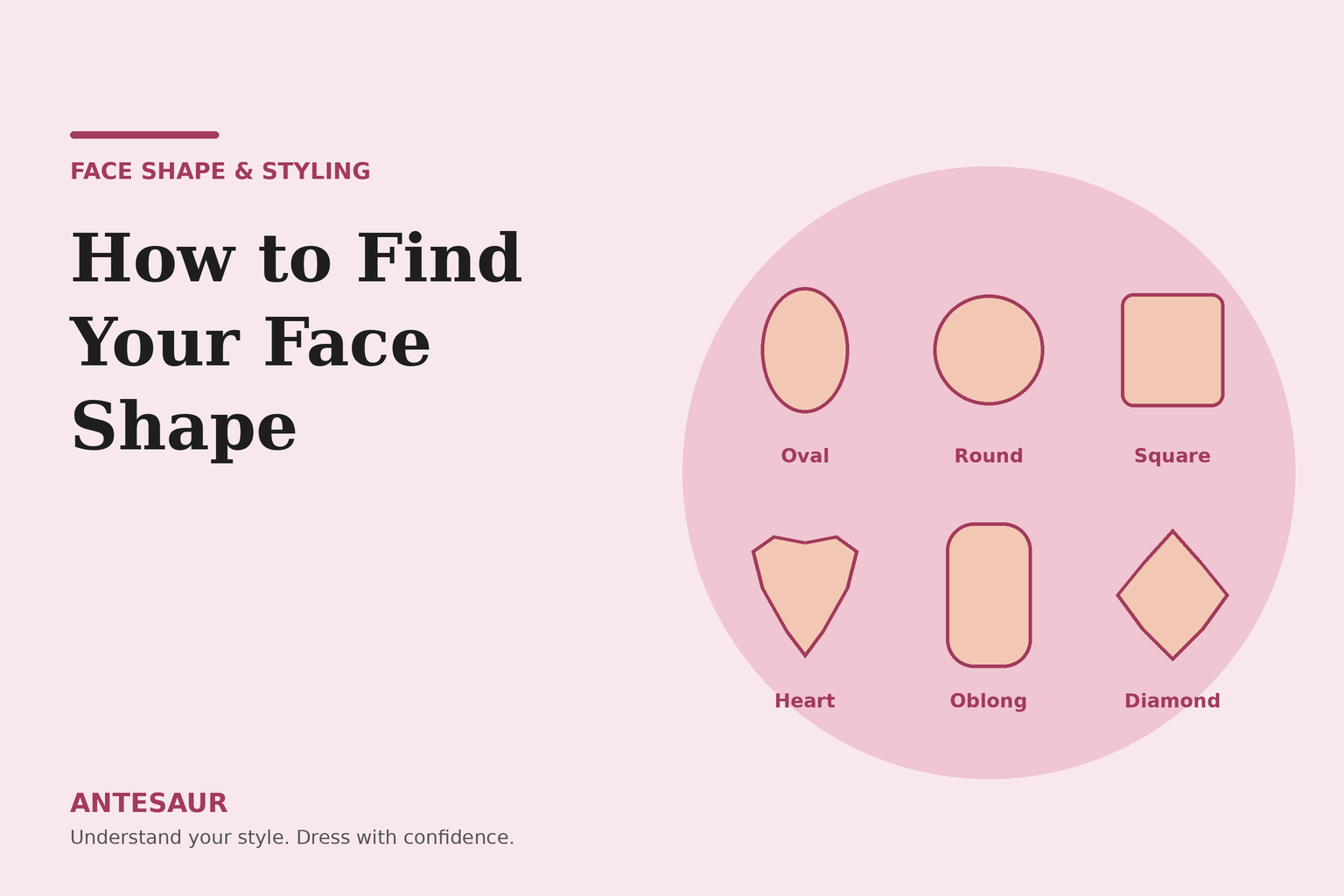
A face shape is the overall outline of your face, determined mainly by the width of your forehead, cheekbones and jawline, and the length of your face from forehead to chin. Experts usually divide faces into six main types: oval, round, square, heart, oblong (also called rectangle or long) and diamond.
Knowing your shape matters because styling works through balance. For example, a round face often looks softer, so structured frames or angular cuts can add definition. A square face has strong angles, so softer curves can balance the look. These are not strict rules, but they are helpful starting points.
Knowing your face shape helps you:
- Choose hairstyles that frame your face well
- Pick glasses and sunglasses that look natural
- Select beard styles that balance your jawline
- Decide on earrings, necklines and collars
- Avoid wasting money on styles that do not suit you
Before You Begin: A Few Important Notes
Face shape is a guide, not a label. Many people sit between two shapes, and that is perfectly normal. Also, your face may appear different depending on weight, hairstyle, angle and lighting. Treat the result as a helpful tool and trust your own comfort and taste.
To get the most accurate result, pull your hair back so your forehead and jawline are fully visible. Remove glasses and caps, stand in good lighting and look straight into the mirror with a neutral expression.
Method 1: The Measurement Method
This is the most accurate method. You will measure four parts of your face.
What You Need
- A soft measuring tape or a ruler
- A mirror
- A notebook or phone for noting down numbers
Step 1: Measure Your Forehead Width
Measure across your forehead at its widest point, usually halfway between your eyebrows and your hairline. Note the number.
Step 2: Measure Your Cheekbones
Measure from the outer edge of one cheekbone to the other. This is usually just under your eyes, across the highest point of your cheeks.
Step 3: Measure Your Jawline
Measure from the point just below your ear to the tip of your chin. Then multiply that number by two to estimate your total jaw width.
Step 4: Measure Your Face Length
Measure from the centre of your hairline to the tip of your chin. This is the total length of your face.
Step 5: Compare the Numbers
Now look at your four numbers.
- If length is much greater than width and all widths are similar, your face is likely oblong.
- If length and width are nearly the same and the jawline is soft, you may have a round face.
- If length and width are similar but the jawline is strong and angular, you may have a square face.
- If your forehead is the widest part and your chin is narrow, you may have a heart shape.
- If your cheekbones are the widest part and both forehead and jaw are narrower, you may have a diamond shape.
- If your face is longer than it is wide and your forehead is wider than your jaw, with a gently rounded chin, you may have an oval face.
Method 2: The Mirror and Marker Method
This method is more visual and does not need numbers.
- Stand about an arm’s length from a mirror.
- Pull your hair back completely.
- Using a washable marker or lipstick, carefully trace the outline of your face on the mirror, following your hairline, cheekbones, jawline and chin.
- Step back and look at the shape you drew.
Is it long and narrow? Round? Angular? Does it taper to a point at the chin? Compare it with the descriptions below. This method works well because you can see the shape clearly, instead of imagining it.
Method 3: The Photo Method
Take a clear, front-facing photo in natural light with your hair pulled back. Keep your face straight, without tilting your head. Then open the photo on your phone and look at your face outline.
Some people draw lines on the photo using an editing app. Mark the width of the forehead, cheekbones and jaw, then see which part is widest and what shape the chin forms. Avoid selfies taken from very close or at an angle, because they distort proportions.
The Six Main Face Shapes Explained
Oval Face
Key features: The face is longer than it is wide. The forehead is slightly wider than the chin, and the jawline is softly rounded. Cheekbones are usually the widest part.
How it looks: Balanced and proportionate, without strong angles.
Styling note: Oval faces are often considered the most versatile, as many hairstyles and frames suit them. The main goal is to keep the natural balance rather than hide the face.
Round Face
Key features: The width and length are nearly equal. Cheeks are full, the jawline is soft and the chin is rounded. There are few sharp angles.
How it looks: Soft, youthful and gentle.
Styling note: To add definition, people often choose styles that create length or angles, such as angular frames and layered cuts.
Square Face
Key features: The forehead, cheekbones and jawline are almost equal in width. The jaw is strong and angular, with a flat hairline.
How it looks: Strong, structured and bold.
Styling note: Softer curves and layers often balance the angular jaw. Many people also like to keep the strength as a feature.
Heart-Shaped Face
Key features: The forehead is the widest part, the cheekbones are high and the face narrows to a pointed or small chin. The hairline may be curved or have a widow’s peak.
How it looks: Wide at the top and delicate at the bottom.
Styling note: Styles that add volume near the jawline and keep the top lighter can balance the shape.
Oblong (Rectangle) Face
Key features: The face is noticeably longer than it is wide. The forehead, cheeks and jaw are about the same width. The chin can be rounded or slightly square.
How it looks: Long and elegant.
Styling note: Styles that add width and reduce the look of length, such as side-swept fringes and fuller sides, can balance the proportions.
Diamond Face
Key features: The cheekbones are the widest part. The forehead and jawline are narrower and the chin is often pointed. High, prominent cheekbones are common.
How it looks: Angular, striking and sculpted.
Styling note: Styles that soften the cheekbones and add width at the forehead and jaw are popular.
Quick Comparison Table
| Face Shape | Widest Part | Jawline | Length vs Width |
| Oval | Cheekbones | Soft, rounded | Longer than wide |
| Round | Cheeks | Soft, rounded | About equal |
| Square | Equal across | Strong, angular | About equal |
| Heart | Forehead | Narrow, pointed chin | Slightly longer |
| Oblong | Equal across | Straight or rounded | Much longer |
| Diamond | Cheekbones | Narrow, pointed chin | Longer than wide |
What If You Fit More Than One Shape?
Many people do. For example, you might have a face that is round with some square features, or an oval with a slightly heart-shaped forehead. In such cases, choose the shape that matches your overall outline and then use ideas from the second shape for details.
Another good approach is to focus on what you want to highlight. If you love your jawline, choose styles that show it. If you want to soften your forehead, choose styles that create gentle framing. Face shape suggestions are tools to support your preferences, not restrictions.
Common Mistakes When Finding Your Face Shape
- Measuring with hair covering your face. Always pull your hair back so you can see the true outline.
- Judging from selfies. Close-up phone cameras stretch the centre of the face and change proportions.
- Confusing weight changes with face shape. Your basic bone structure stays the same even if your cheeks look fuller or thinner.
- Choosing a shape you wish you had. Be honest about your actual outline.
- Treating the result as a strict rule. Style is about confidence as much as balance.
How Face Shape Connects with Your Overall Style
Face shape is just one part of your look. Your clothes, colours and fit also contribute to the overall impression. If you want to build a complete personal style, start with our guide on how to find your personal style. For clothing balance, you can also learn about common fit mistakes that ruin an outfit.
Necklines can also work with your face shape. For example, a V-neck T-shirt tends to lengthen the neck and softens round faces, while a crew neck can balance longer faces. If you need help with choosing the right collars, you can explore our guide on crew neck vs V-neck vs polo.
Next Steps After You Identify Your Face Shape
Now that you know your shape, here is how to use it.
- Explore hairstyles. Read our full guide to best hairstyles for every face shape to find cuts that suit your outline.
- Choose better glasses. Learn which frames suit your shape in our guide to best glasses frames for your face shape.
- Match accessories. Earrings, hats, sunglasses and necklaces all look better when chosen with your shape in mind.
- Experiment slowly. Try one change at a time, so you can see what really works.
Frequently Asked Questions
Can my face shape change over time?
Your bone structure stays mostly the same, but weight changes, age and muscle tone can make your face look slightly different. The overall shape usually remains consistent.
Which face shape is the most common?
It varies, but oval and round shapes are often mentioned as common. Many people also have mixed shapes, so do not worry about fitting a perfect category.
Is the oval face the best face shape?
No. Oval is often called versatile because many styles suit it, but every face shape has its own beauty. Strong jawlines, high cheekbones and soft curves are all attractive.
Can men use face shape guides too?
Yes. Men can use face shape to choose haircuts, beard styles, glasses and even collar types. The same principles of balance apply.
Do I need professional help to find my face shape?
Not usually. The measurement or mirror method is accurate enough for styling decisions. A hairstylist or optician can also confirm your shape in person.
Final Thoughts
Finding your face shape is a small step that can make a big difference to how you style yourself. In just a few minutes, you can measure your forehead, cheekbones, jawline and face length, compare the results and identify your natural outline.
Use your result as a helpful guide when choosing hairstyles, glasses and accessories, but always keep your own comfort and taste in mind. Style works best when it supports who you are. To continue learning, browse the rest of our Face Shape & Styling guides.
Pingback: Best Hairstyles for Every Face Shape (Men & Women) - Antesaur
Pingback: Best Glasses Frames for Your Face Shape: Complete Guide - Antesaur