Introduction
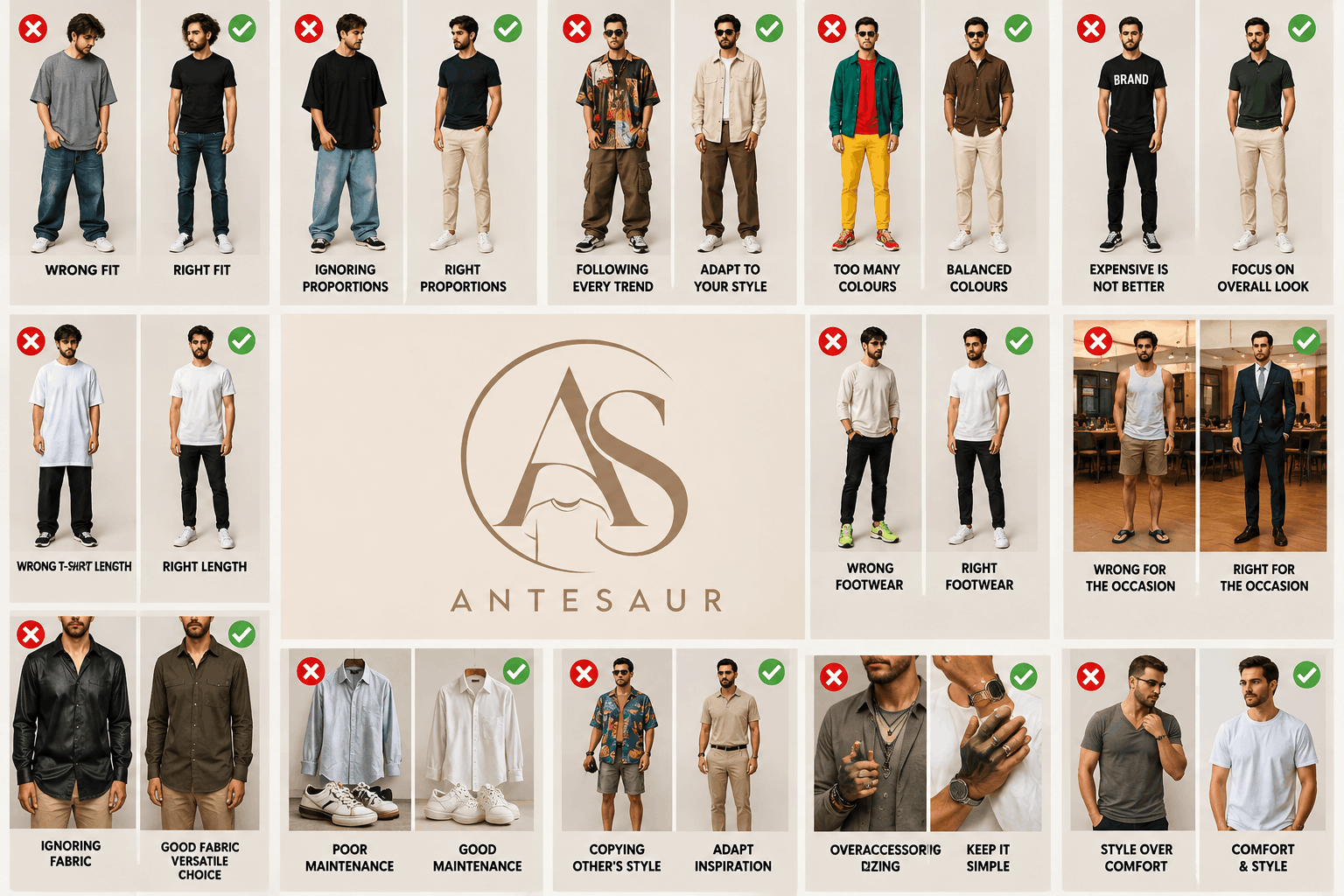
Looking stylish isn’t always about wearing expensive clothes or following the latest trends. Sometimes, a simple outfit can look better than an expensive one when the fit, colours, proportions, and overall styling are right.
The problem is that many people unknowingly make small fashion mistakes that affect the way their outfits look. Wearing the wrong size, choosing colours that don’t work together, copying trends blindly, or ignoring proportions can make even good clothing look less polished.
The good news is that you don’t need to completely change your wardrobe to improve your style. Once you understand the most common fashion mistakes, you can start making better choices with the clothes you already own.
In this guide, we’ll break down the most common mistakes people make and explain simple ways to avoid them.
1. Wearing the Wrong Fit
One of the biggest fashion mistakes is wearing clothing that doesn’t fit properly.
Some people choose clothes that are too tight because they believe fitted clothing looks smarter. Others buy extremely oversized clothing because they want a relaxed look.
Both can work when intentional, but the problem starts when the proportions aren’t right.
Why Fit Matters
The fit of your clothes affects the entire appearance of your outfit.
A T-shirt that is too tight can pull around the chest and stomach, while one that is excessively loose can make your body proportions look less balanced.
Similarly, trousers that are too long can bunch around the ankles, while trousers that are too short can make the outfit look unfinished.
What You Should Check
Before buying or wearing a garment, look at:
- Shoulder placement
- Chest and waist fit
- Sleeve length
- T-shirt length
- Trouser length
- Overall silhouette
The size printed on the label isn’t everything. Different brands use different measurements, so focus on how the garment actually fits your body.
2. Ignoring Proportions
A second common mistake is focusing on individual clothing pieces without considering how they work together.
A shirt may fit perfectly by itself, and your trousers may also fit perfectly, but combining them can still create an unbalanced silhouette.
Understanding Outfit Proportions
Think about the visual relationship between your upper and lower body.
For example:
Oversized T-shirt + extremely wide trousers
creates a very loose silhouette.
On the other hand:
Fitted T-shirt + relaxed trousers
creates more contrast between the upper and lower body.
Neither approach is automatically right or wrong. The key is understanding what effect you’re creating.
Simple Rule
If one part of your outfit has a lot of volume, consider keeping another part more structured.
This doesn’t mean you have to follow strict fashion rules. It simply gives you more control over your overall appearance.
3. Following Every Trend
Fashion trends can be useful for discovering new ideas, but following every trend can make your wardrobe feel inconsistent.
Something can look great on a model or influencer but still not suit your personal style.
Why This Happens
People often see a trending outfit and immediately try to recreate it without considering:
- Their body proportions
- Their lifestyle
- Their existing wardrobe
- Their comfort level
- Their personal preferences
Better Approach
Instead of copying an entire trend, take one element from it.
For example, if oversized T-shirts are trending, you don’t need to replace your entire wardrobe with oversized clothing.
Try one oversized piece and see how it works with your existing jeans, trousers, and footwear.
Use trends as inspiration, not instructions.
4. Using Too Many Colours
Colour is one of the easiest ways to make an outfit interesting, but using too many unrelated colours can make it look chaotic.
This doesn’t mean you should only wear black, white, and grey.
The goal is to create some visual connection between the colours you’re wearing.
A Simple Colour Formula
A useful starting point is:
Main colour + supporting colour + optional accent colour
For example:
- Black + white + beige
- Navy + white + brown
- Grey + black + burgundy
- Cream + olive + brown
These combinations give you enough contrast without making the outfit unnecessarily complicated.
Start With Neutrals
If you’re unsure about colours, build your wardrobe around versatile shades such as:
- Black
- White
- Grey
- Navy
- Beige
- Brown
- Olive
Once you’re comfortable with these, you can gradually experiment with stronger colours.
5. Choosing Clothes Only Because They Are Expensive
Price and style are not the same thing.
An expensive shirt can still look bad if the fit is wrong, while an affordable T-shirt can look excellent when it fits well and works with the rest of the outfit.
What Matters More Than Price?
Pay attention to:
- Fit
- Fabric
- Construction
- Colour
- Proportion
- Versatility
- Condition
A higher price doesn’t automatically guarantee better styling.
The goal should be to buy clothes that work for you, not simply clothes with a higher price tag.
6. Wearing the Wrong T-Shirt Length
T-shirts are one of the most frequently worn pieces in a wardrobe, but their length is often overlooked.
Many people focus only on the chest and shoulder fit while ignoring where the T-shirt ends on the body. A T-shirt that is too long can make the legs appear shorter, while one that is too short can look uncomfortable and poorly proportioned.
What Is the Right T-Shirt Length?
For a regular-fit T-shirt, the hem generally works well around the hip area. However, the ideal length depends on your height, body proportions, trouser rise, and preferred style.
For an oversized T-shirt, a slightly longer length can work because the entire garment is designed around a relaxed silhouette.
Don’t Judge a T-Shirt by Width Alone
When buying a T-shirt, check:
- Shoulder position
- Chest width
- Sleeve length
- Overall body length
- How the hem sits with your trousers
A T-shirt can have the right chest measurement and still look wrong if the length doesn’t work with your proportions.
7. Choosing the Wrong Footwear
Shoes can completely change the way an outfit looks.
You can have a well-fitted T-shirt, good trousers, and coordinated colours, but the wrong footwear can make the entire outfit feel disconnected.
Match Your Shoes With the Outfit
Different types of footwear create different visual impressions.
For example:
- Minimal sneakers work well with everyday casual outfits.
- Loafers can make an outfit look more refined.
- Boots can add structure to certain casual and smart-casual outfits.
- Athletic running shoes may not work with every casual outfit.
The goal isn’t to own dozens of pairs.
Instead, choose versatile footwear that works with most of your existing wardrobe.
Keep Your Shoes Clean
Even the right pair of shoes can look bad when they’re dirty or poorly maintained.
Regularly clean your footwear and check for visible damage before wearing it.
8. Dressing Wrong for the Occasion
An outfit can look good and still be completely wrong for the situation.
Wearing casual streetwear to a formal event or an overly formal outfit to a relaxed gathering can make you feel uncomfortable and out of place.
Ask Yourself These Questions
Before getting dressed, consider:
- Where am I going?
- What type of event is it?
- What will other people likely be wearing?
- Will I be walking or sitting for long periods?
- What is the weather like?
- Is there a specific dress code?
These simple questions can prevent many unnecessary styling mistakes.
Dress Appropriately First
Your personal style should work within the expectations of the occasion.
A useful approach is:
Occasion → Comfort → Personal Style
Understand the situation first, choose something comfortable, and then add your own personality through colours, accessories, footwear, or fit.
9. Ignoring Fabric and Material
A common fashion mistake is focusing entirely on how clothing looks while ignoring what it is made from.
Fabric affects how a garment feels, moves, drapes, breathes, and performs over time.
Why Fabric Matters
The same design can look completely different depending on the material.
Fabric can influence:
- Comfort
- Breathability
- Durability
- Shape
- Weight
- Texture
- Drape
- Maintenance
For example, lightweight and breathable fabrics may be more comfortable in hot weather, while heavier materials can provide warmth and structure in cooler conditions.
Check the Care Label
Before buying clothing, check the care instructions.
A garment that requires complicated maintenance may not be practical for your everyday lifestyle.
Choose materials based not only on appearance but also on climate, comfort, usage, and maintenance.
10. Buying Clothes Without Considering Your Existing Wardrobe
Another common mistake is buying individual clothing pieces simply because they look good in the store.
The problem appears later when you realise that the new item doesn’t work with anything else you own.
You may end up with a wardrobe full of interesting pieces but very few complete outfits.
Ask Yourself Before Buying
Before purchasing something new, ask:
“How many outfits can I create with this?”
If you can combine it with several items you already own, it’s likely to be more useful.
For example, a neutral T-shirt that works with jeans, chinos, shorts, and trousers may provide more value than a statement piece that only works with one outfit.
Build Around Versatility
A practical wardrobe should contain a mixture of:
- Everyday basics
- Neutral colours
- Versatile trousers
- Reliable footwear
- A few statement pieces
- Seasonal clothing
This makes it easier to create different outfits without constantly buying new clothes.
11. Wearing Clothes That Need Maintenance
Even great clothing can look bad when it isn’t properly maintained.
Wrinkled shirts, dirty shoes, faded colours, loose threads, stains, and damaged collars can make an outfit look careless.
Common Maintenance Mistakes
Some people:
- Ignore care labels
- Leave clothes wrinkled
- Store clothing incorrectly
- Wear dirty footwear
- Keep damaged clothing for too long
- Wash garments unnecessarily
Better Clothing Care
Simple maintenance can significantly improve how your wardrobe looks.
Try to:
- Follow washing instructions
- Iron or steam garments when necessary
- Clean shoes regularly
- Remove stains quickly
- Store clothes appropriately
- Repair minor damage when possible
You don’t need expensive clothing to look polished.
Clean, well-maintained clothing will almost always look better than neglected expensive clothing.
12. Copying Someone Else’s Style Completely
Getting inspiration from celebrities, influencers, Pinterest, or social media can help you discover new outfit ideas.
The mistake is copying someone else’s entire style without considering whether it actually works for you.
Everyone has different:
- Body proportions
- Lifestyle
- Climate
- Budget
- Comfort preferences
- Personality
- Daily activities
An outfit that looks great on someone else may not create the same effect on you.
Take Inspiration, Don’t Copy
Instead of copying an entire outfit, identify what you actually like about it.
It could be:
- The colour combination
- The silhouette
- The layering
- The footwear
- The simplicity
- The accessories
Then adapt that element to your own wardrobe.
This helps you develop a style that feels natural rather than forced.
13. Overaccessorizing an Outfit
Accessories can add personality and make a simple outfit more interesting.
However, wearing too many accessories at once can create unnecessary visual clutter.
For example, wearing multiple necklaces, rings, bracelets, a large watch, statement sunglasses, and several other accessories together can make the outfit feel overloaded.
Keep Accessories Intentional
You don’t need to wear every accessory you own.
Start with one or two pieces that complement the outfit.
For example:
Simple T-shirt + jeans + watch
can already look complete.
If you add another accessory, make sure it contributes to the overall look rather than simply adding more detail.
Let One Piece Stand Out
If you’re wearing a statement accessory, allow it to become the focal point.
When everything is trying to stand out, nothing actually stands out.
14. Choosing Style Over Comfort
Looking stylish shouldn’t mean spending the entire day feeling uncomfortable.
If your shoes hurt, your trousers restrict movement, or your T-shirt feels too tight, you’ll probably keep adjusting your clothes throughout the day.
That can make you feel less confident rather than more stylish.
Find the Right Balance
A practical outfit should combine:
Style + Fit + Comfort
You don’t have to sacrifice style for comfort.
Instead, look for clothing that provides both.
For example, a well-fitted relaxed T-shirt can provide a comfortable alternative to an extremely tight T-shirt without making the outfit look sloppy.
Consider Your Lifestyle
Your clothes should work for the activities you actually do.
If you spend most of your day walking or travelling, comfortable footwear and breathable clothing may be more important than wearing something purely for appearance.
Good style should fit into your life, not make your life harder.
15. Buying Clothes That Don’t Fit Your Current Body
Another common mistake is buying clothes based on the body you hope to have rather than the body you have today.
Some people buy clothes that are too small because they expect to lose weight later.
Others buy extremely loose clothing because they think they may need the extra room in the future.
Buy for Your Current Needs
Your wardrobe should serve you now.
Choose clothing that fits your current body comfortably and looks good on you today.
If your body changes in the future, you can adjust your wardrobe at that time.
Don’t Confuse Oversized With Too Large
Oversized clothing is designed with specific proportions.
Simply buying two or three sizes larger doesn’t automatically create a stylish oversized look.
Look for garments intentionally designed with:
- Dropped shoulders
- Longer sleeves
- Wider body
- Appropriate garment length
This creates a controlled oversized silhouette instead of an accidental one.
16. Wearing Clothes That Don’t Suit Your Proportions
Not every clothing cut works equally well for every body proportion.
This doesn’t mean that certain clothes are permanently off-limits.
It means understanding how different cuts change the visual balance of your outfit.
Pay Attention to Visual Balance
For example:
- High-rise trousers can visually lengthen the legs.
- A shorter jacket can emphasize the waist.
- Long outerwear can create a more elongated silhouette.
- Oversized tops can add visual volume to the upper body.
These effects can be used intentionally to create the appearance you prefer.
Experiment Instead of Following Rules
There is no single “perfect” outfit for every body type.
Try different:
- T-shirt lengths
- Trouser rises
- Fits
- Layers
- Silhouettes
Then pay attention to what makes you feel comfortable and confident.
17. Wearing Too Many Statement Pieces
Statement clothing can make an outfit memorable, but using several statement pieces together can make the outfit feel chaotic.
For example:
Bold graphic T-shirt + bright trousers + statement sneakers + oversized accessories
may create too many competing focal points.
Choose One Main Focus
If one piece is bold, allow the rest of the outfit to support it.
For example:
Graphic T-shirt + neutral trousers + simple sneakers
creates a more balanced outfit.
The same principle works with:
- Statement jackets
- Bold footwear
- Bright colours
- Large accessories
- Strong patterns
One strong element is often enough.
18. Ignoring the Importance of Grooming
Clothing is only one part of your overall appearance.
Even a well-planned outfit can look less polished if basic grooming is ignored.
This doesn’t mean you need an elaborate grooming routine.
Simple things can make a difference:
- Clean hair
- Clean shoes
- Well-maintained clothing
- Clean nails
- Fresh appearance
- Appropriate personal hygiene
Style and Grooming Work Together
Think of your outfit as part of the bigger picture.
You don’t need to look perfect.
You simply need to look clean, intentional, and comfortable.
19. Thinking Expensive Brands Automatically Mean Better Style
A designer logo doesn’t automatically make an outfit stylish.
Brand names can influence quality, design, or perception, but they don’t replace good styling.
A simple outfit from affordable brands can look better than an expensive outfit when the cheaper outfit has:
- Better fit
- Better colour coordination
- Better proportions
- Better footwear
- Better maintenance
Focus on Value, Not Just Labels
Before buying something because of its brand, ask:
Does this actually improve my wardrobe?
If the answer is no, the logo isn’t going to fix the problem.
20. Trying Too Hard With Every Outfit
One of the most overlooked fashion mistakes is overthinking every outfit.
Some people believe that looking stylish requires complicated layering, bold colours, expensive accessories, and constantly changing trends.
It doesn’t.
Simplicity Can Be Powerful
A clean combination such as:
Well-fitted T-shirt + straight jeans + clean sneakers
can look more polished than a complicated outfit with too many competing elements.
The goal isn’t to make every outfit impressive.
The goal is to make your outfit intentional and appropriate.
21. Not Developing a Personal Style
Following trends, copying outfits, and buying random clothing can eventually leave you with a wardrobe that doesn’t feel like you.
Personal style develops when you understand what you consistently enjoy wearing.
Start Identifying Your Style
Pay attention to:
- Colours you repeatedly choose
- Fits you feel comfortable wearing
- Outfits you receive compliments on
- Clothing you wear most often
- Styles you naturally save or notice
- Pieces that make you feel confident
Over time, these patterns reveal your personal style.
Your wardrobe should reflect you, not just what’s popular.
How to Avoid Common Fashion Mistakes
Knowing the mistakes is useful, but the real improvement comes from changing your everyday habits.
You don’t need to replace your entire wardrobe. Start by becoming more intentional about how you choose, combine, wear, and maintain your clothes.
1. Understand Your Preferred Fit
Start by identifying the fits you genuinely enjoy wearing.
You might prefer:
- Slim fit
- Regular fit
- Relaxed fit
- Oversized fit
You don’t have to stick to one fit forever. The important thing is understanding how each silhouette changes the overall appearance of an outfit.
2. Build Around Versatile Pieces
Before buying another statement piece, make sure your wardrobe has enough versatile basics.
Useful foundation pieces can include:
- Plain T-shirts
- Well-fitting jeans
- Neutral trousers
- Casual shirts
- Clean sneakers
- Simple outerwear
These pieces can be combined in many different ways.
3. Improve Your Colour Combinations
If you frequently struggle with colours, start with neutral shades.
Build combinations around:
- Black
- White
- Grey
- Navy
- Beige
- Brown
- Olive
Once you’re comfortable, introduce stronger colours gradually.
4. Think About Proportions
Before leaving the house, look at the complete silhouette rather than individual garments.
Ask yourself:
Does the top work with the bottom?
Does the footwear balance the outfit?
Is one piece dominating the entire look?
These simple questions can help you identify proportion problems quickly.
5. Dress for the Occasion
Always consider the environment before deciding what to wear.
Your personal style should adapt to:
- Work
- College
- Casual outings
- Parties
- Dates
- Weddings
- Travel
- Formal events
Being appropriately dressed is an important part of having good style.
A Simple 30-Second Outfit Check
Before leaving home, use this quick checklist.
1. Fit
Does everything fit properly?
2. Proportion
Do the top and bottom create a balanced silhouette?
3. Colour
Do the colours work well together?
4. Occasion
Is the outfit appropriate for where you’re going?
5. Footwear
Does your footwear match the overall outfit?
6. Condition
Are your clothes clean, wrinkle-free, and properly maintained?
7. Comfort
Can you comfortably wear the outfit for several hours?
If all seven answers are yes, you’ve already avoided many common fashion mistakes.
Common Fashion Mistakes vs Better Choices
| Common Fashion Mistake | Better Choice |
|---|---|
| Wearing the wrong size | Check measurements and overall fit |
| Following every trend | Adapt trends to your personal style |
| Using too many colours | Build around a simple colour palette |
| Ignoring proportions | Balance the volume of your outfit |
| Choosing the wrong T-shirt length | Consider both width and length |
| Wearing unsuitable footwear | Match footwear with the outfit |
| Dressing incorrectly for an occasion | Understand the expected dress level |
| Ignoring fabric | Choose materials based on comfort and climate |
| Buying random clothes | Buy pieces that work with your wardrobe |
| Poor clothing maintenance | Clean, store, and care for clothes properly |
| Copying someone else’s style | Use inspiration and adapt it |
| Overaccessorizing | Keep accessories intentional |
| Choosing style over comfort | Balance style, fit, and comfort |
| Buying only because of the brand | Focus on quality, fit, and versatility |
| Overcomplicating outfits | Keep the overall look balanced |
Common Fashion Mistakes: Quick Checklist
Before purchasing or wearing something, ask yourself:
Does It Fit?
The garment should sit comfortably without being unnecessarily tight or loose.
Does It Work With My Wardrobe?
A new item should ideally create multiple outfit possibilities.
Do the Colours Work?
Check whether the colours complement rather than compete with each other.
Is It Right for the Occasion?
A great outfit can still be wrong for the situation.
Is It Comfortable?
If you’re uncomfortable, you’ll probably spend the day adjusting your clothes.
Does It Feel Like Me?
Your wardrobe should reflect your personality rather than simply copying someone else’s style.
Will I Actually Wear It?
This is one of the most important questions before buying anything.
Frequently Asked Questions
What are the most common fashion mistakes?
Some of the most common fashion mistakes include wearing the wrong fit, ignoring proportions, using too many colours, following trends blindly, choosing inappropriate footwear, and buying clothes without considering your existing wardrobe.
Is wearing expensive clothing a guarantee of good style?
No. Price and personal style are not the same thing. Fit, proportions, colour coordination, clothing condition, and overall styling usually have a much bigger impact.
How can I avoid fashion mistakes?
Start by understanding your preferred fit, building around versatile clothing, coordinating colours, considering proportions, dressing appropriately for occasions, and keeping your clothes well maintained.
Is oversized clothing a fashion mistake?
No. Oversized clothing can look stylish when the proportions are intentional. Simply buying several sizes larger than your normal size can create an unbalanced look.
How many colours should I wear in an outfit?
There is no strict rule, but starting with one main colour, one supporting colour, and an optional accent is an easy way to create balanced combinations.
Can simple outfits look stylish?
Absolutely. A well-fitted T-shirt, good trousers, clean footwear, and a coordinated colour combination can create a stylish everyday outfit without being complicated.
Should I follow fashion trends?
Trends can provide inspiration, but you don’t need to follow every trend. Choose trends that fit your personal style, lifestyle, comfort, and existing wardrobe.
How can I improve my style without buying new clothes?
Start by reorganizing your existing wardrobe, creating new combinations, improving fit and proportions, maintaining your clothes, and experimenting with different colour combinations.
Final Thoughts
Most fashion mistakes aren’t caused by a lack of clothes.
They’re caused by poor choices with the clothes you already have.
The wrong fit, unbalanced proportions, excessive colours, inappropriate footwear, poor maintenance, and blind trend-following can all make an outfit look less polished.
You don’t need to chase every new trend or spend a fortune on clothing.
Start with the basics:
Fit. Proportion. Colour. Occasion. Comfort. Maintenance.
Once you understand these fundamentals, getting dressed becomes much easier.
The goal isn’t to create a perfect outfit every single day.
The goal is to develop a wardrobe that works for your body, your lifestyle, and your personal style.
Understand your style. Dress with confidence.