Introduction
Buying the perfect T-shirt isn’t just about choosing the right colour or design—it’s about finding the right size. Even a premium-quality T-shirt can look uncomfortable or unflattering if the size isn’t correct. A well-sized T-shirt enhances your body shape, improves comfort, and gives you a clean, confident appearance.
Many people rely only on labels like Small, Medium, Large, or XL when shopping. However, sizing varies between brands, and choosing the wrong size is one of the biggest reasons for returns and dissatisfaction.
Whether you’re shopping online or in-store, understanding how a T-shirt should fit can save you time and money. From shoulder seams and chest measurements to sleeve length and body length, every detail plays a role in achieving the perfect fit.
In this complete guide, you’ll learn how to choose the right T-shirt size, understand size charts, measure yourself correctly, avoid common sizing mistakes, and confidently find the perfect fit for your body type.
Why Choosing the Right T-Shirt Size Matters
The correct T-shirt size affects far more than just comfort. It influences how your body proportions appear, how confident you feel, and even how long your clothing lasts.
A properly fitted T-shirt should:
- Sit naturally on your shoulders
- Feel comfortable around the chest
- Allow free movement
- End around the middle of your zipper area
- Have sleeves that complement your arms
When your T-shirt fits correctly, it creates a balanced silhouette that works well with jeans, chinos, shorts, and jackets.
On the other hand, wearing the wrong size can make even expensive clothing look untidy.
Common issues include:
- Tight shoulders
- Loose necklines
- Sleeves that are too long
- Excessively short body length
- Fabric pulling across the chest
Choosing the right size is the foundation of good style.
Understanding Standard T-Shirt Sizes
Most brands use standard international sizing, but the actual measurements may differ slightly from one manufacturer to another.
The most common sizes include:
- Small (S)
- Medium (M)
- Large (L)
- Extra Large (XL)
- Double XL (XXL)
- Triple XL (3XL)
These labels provide a general guideline, but they should never replace checking the actual measurement chart.
For example, one brand’s Medium may have the same chest measurement as another brand’s Large.
That’s why measuring yourself is always the best approach.
Size Labels vs Actual Measurements
Many shoppers assume that wearing Medium in one brand guarantees the same size everywhere.
Unfortunately, this isn’t true.
Always compare:
- Chest Width
- Shoulder Width
- Body Length
- Sleeve Length
Instead of relying only on the letter printed on the tag.
How Should a T-Shirt Fit?
A perfect T-shirt should balance comfort and appearance.
Here are the areas you should check before buying.
Shoulder Fit
The shoulder seam should end close to your natural shoulder.
If the seam extends too far down the arm, the shirt is too large.
If it sits inside your shoulder, it’s too small.
Chest Fit
The chest should feel comfortable without pulling or excessive looseness.
You should be able to move naturally while maintaining a clean silhouette.
Sleeve Fit
Sleeves should end around the middle of your upper arm for a classic fit.
Slim-fit styles may have slightly shorter sleeves, while relaxed and oversized styles may extend closer to the elbow.
Body Length
The ideal T-shirt length ends around the middle of the zipper area.
It shouldn’t expose your waist when raising your arms, nor should it extend excessively below your hips.
Neckline
The collar should sit comfortably around your neck without stretching or sagging.
A well-made neckline keeps its shape even after multiple washes.
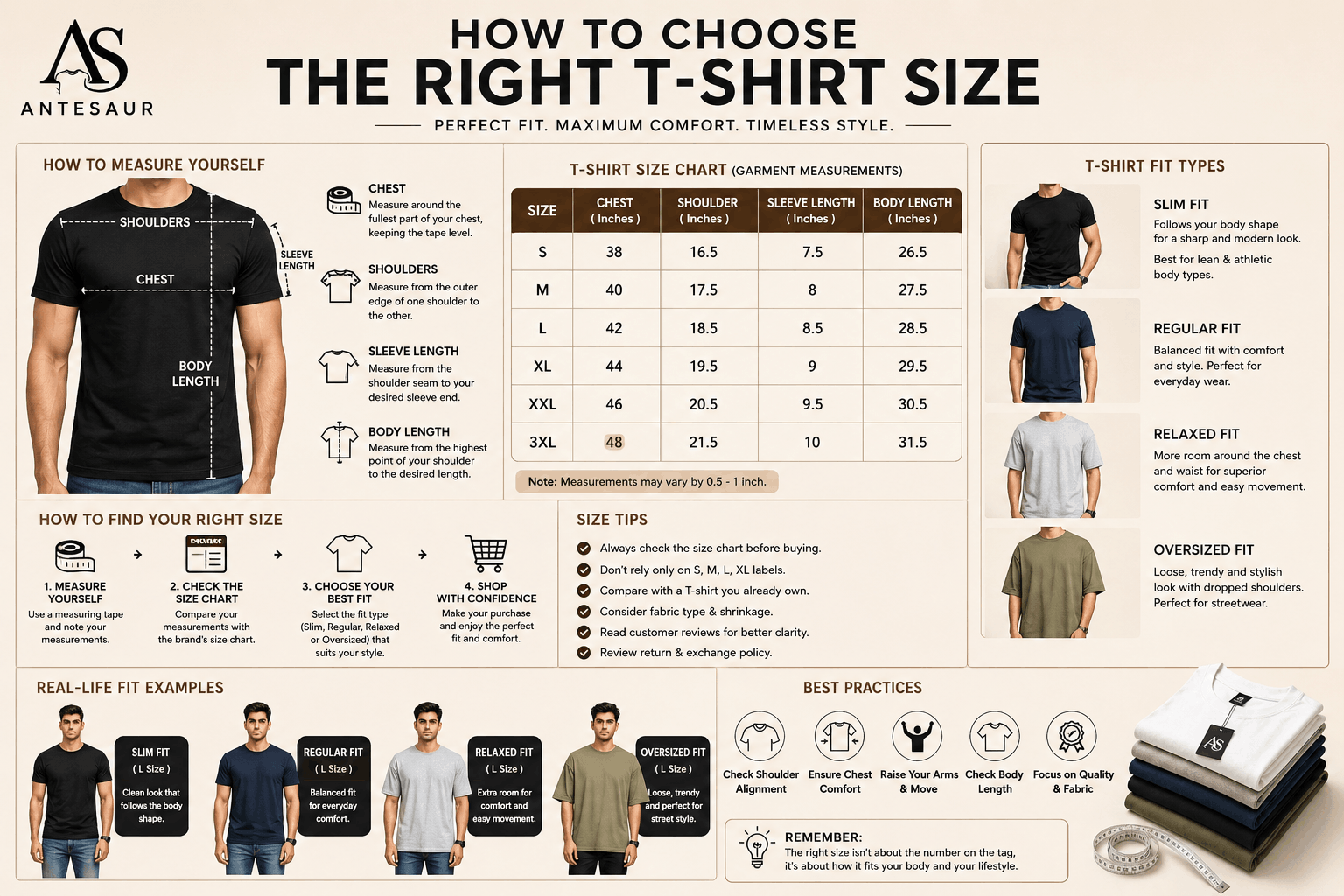
How to Measure Yourself Correctly
Knowing your body measurements is the easiest way to choose the correct T-shirt size. A measuring tape is all you need.
For the most accurate results, stand naturally without puffing your chest or pulling in your stomach.
Measure Your Chest
Wrap the measuring tape around the fullest part of your chest while keeping it level across your back.
Do not pull the tape too tightly.
The tape should fit comfortably without compressing your body.
This is the most important measurement when selecting a T-shirt.
Measure Your Shoulders
Measure from the outer edge of one shoulder to the other across your upper back.
This helps determine whether the shoulder seams will sit correctly.
Measure Your Sleeve Length
Measure from the shoulder seam down to where you’d like the sleeve to end.
For regular-fit T-shirts, sleeves usually finish around the middle of the upper arm.
Measure Your Body Length
Measure from the highest point of your shoulder down to your desired T-shirt length.
A properly sized T-shirt should end around the middle of your trouser zipper.
Measure Your Neck
Although less important for crew-neck T-shirts, neck measurement can help when choosing polo shirts and Henley T-shirts.
Understanding Size Charts
Every clothing brand uses its own size chart.
Never assume that Medium in one brand equals Medium in another.
Before placing an online order, compare your body measurements with the brand’s official size chart.
Most size charts include:
- Chest
- Shoulder
- Body Length
- Sleeve Length
These measurements are much more reliable than simply selecting Small, Medium, or Large.
Understanding Garment Measurements vs Body Measurements
Many people confuse garment measurements with body measurements.
They’re completely different.
Body Measurements
These are your actual body dimensions.
Example:
Chest: 40 inches
Garment Measurements
These refer to the T-shirt itself.
A T-shirt made for a 40-inch chest may actually measure 42–44 inches to provide comfortable movement.
Always read whether the brand is displaying body measurements or garment measurements.
Common T-Shirt Fit Types
Choosing the correct size also depends on the fit you prefer.
Slim Fit
Slim-fit T-shirts follow the body’s natural shape.
Best for:
- Smart Casual
- Office Casual
- Layering
- Athletic Body Types
Provides a clean and modern appearance.
Regular Fit
Regular fit offers balanced proportions.
Best for:
- Everyday Wear
- College
- Office
- Travel
One of the most versatile fits available.
Relaxed Fit
Relaxed-fit T-shirts provide additional room around the chest and waist.
Best for:
- Weekend Wear
- Travel
- Casual Outings
Prioritizes comfort without looking oversized.
Oversized Fit
Oversized clothing is intentionally designed with:
- Dropped Shoulders
- Longer Sleeves
- Wider Chest
- Loose Silhouette
Perfect for:
- Streetwear
- Casual Fashion
- Layering
Choosing the Right Size for Different Body Types
Everyone’s body is different.
Choosing the correct size depends on both measurements and body proportions.
Slim Body Type
If you have a lean frame:
Choose:
- Slim Fit
- Regular Fit
Avoid buying oversized clothing that’s too large, as it may overwhelm your frame.
Athletic Body Type
Broad shoulders and a defined chest suit:
- Slim Fit
- Regular Fit
- Relaxed Fit
Avoid sizes that restrict shoulder movement.
Broad Body Type
Choose clothing that provides comfort without looking excessively loose.
Recommended:
- Regular Fit
- Relaxed Fit
Avoid sizing down to achieve a slimmer appearance.
Short Height
Choose:
- Regular Fit
- Slim Fit
Avoid T-shirts that extend too far below your hips, as they can make your legs appear shorter.
Tall Height
Tall individuals have greater flexibility.
They can comfortably wear:
- Slim Fit
- Regular Fit
- Relaxed Fit
- Oversized Fit
Choose the fit based on your personal style.
Size Tips for Online Shopping
Shopping online can be challenging, but these tips help reduce sizing mistakes.
- Always check the size chart.
- Measure yourself before ordering.
- Read customer reviews.
- Compare measurements with a T-shirt you already own.
- Check whether the fabric stretches.
- Read the return policy before purchasing.
These simple steps greatly improve your chances of choosing the correct size.
Size Tips for Different Fabrics
Fabric affects how a T-shirt fits after washing.
100% Cotton
Soft and breathable but may shrink slightly if washed incorrectly.
Cotton Blend
Provides better shape retention with minimal shrinkage.
Heavyweight Cotton
Offers a structured appearance and maintains its fit well.
Linen
Breathable and lightweight, ideal for hot weather but may wrinkle more easily.
Common T-Shirt Sizing Mistakes
Even experienced shoppers often choose the wrong T-shirt size. Avoiding these common mistakes will help you build a wardrobe that looks better and feels more comfortable.
Choosing Size Based Only on Labels
Many people automatically buy Medium, Large, or XL without checking the actual measurements.
The problem is that sizing varies between brands.
Instead of relying only on the label, always compare:
- Chest measurement
- Shoulder width
- Body length
- Sleeve length
Buying a Smaller Size to Look Slimmer
Some people intentionally buy a smaller T-shirt hoping it will create a lean appearance.
Instead, it usually causes:
- Tight shoulders
- Fabric pulling across the chest
- Restricted movement
- Short body length
A properly fitted T-shirt always looks better than one that’s too tight.
Buying a Larger Size for Comfort
Going one or two sizes larger isn’t always the right solution.
An oversized T-shirt is specially designed with different proportions.
Buying a larger regular-fit T-shirt often results in:
- Drooping shoulders
- Excessive length
- Loose neckline
- Poor overall appearance
If you want a loose look, choose a genuine relaxed-fit or oversized T-shirt.
Ignoring Shoulder Fit
The shoulder seam is one of the easiest ways to judge whether a T-shirt fits properly.
If the seam sits:
- Too far inside → Too Small
- Too far down the arm → Too Large
Correct shoulder alignment instantly improves your overall appearance.
Not Considering Fabric Shrinkage
Natural cotton fabrics may shrink slightly after washing.
Before buying:
- Read the washing instructions.
- Check if the fabric is pre-shrunk.
- Follow the recommended wash temperature.
Proper care helps maintain the original fit.
Ignoring Body Length
Many people focus only on chest size.
Body length is equally important.
A good T-shirt should:
- Cover the waistband.
- Stay in place when raising your arms.
- Avoid looking excessively long.
Expert Tips Before Buying a T-Shirt
Fashion experts recommend focusing on fit before colour or branding.
Try the Shoulder Test
The shoulder seam should sit close to your natural shoulder bone.
This simple test immediately tells whether the size is correct.
Raise Your Arms
Lift both arms above your head.
A properly fitted T-shirt should remain comfortable without exposing too much of your waist.
Sit Down
Sit naturally while wearing the T-shirt.
Check whether:
- The fabric feels tight.
- The collar remains comfortable.
- The body length still looks balanced.
Move Naturally
Walk, bend, and stretch.
You should never feel restricted.
Comfort is just as important as appearance.
Compare With Your Favourite T-Shirt
One of the easiest methods is comparing measurements with a T-shirt you already love.
Measure:
- Chest
- Shoulder
- Length
- Sleeves
Then compare them with the brand’s size chart.
T-Shirt Size Checklist
Before purchasing, ask yourself:
- ✅ Does the shoulder seam sit correctly?
- ✅ Is the chest comfortable?
- ✅ Can I move freely?
- ✅ Is the sleeve length appropriate?
- ✅ Does the body length cover the waistband?
- ✅ Does the fabric feel comfortable?
- ✅ Does this fit match my personal style?
If you answered Yes to all of these, you’ve likely found the right size.
Best Practices
| Do | Don’t |
|---|---|
| Measure yourself before buying | Guess your size |
| Check the brand’s size chart | Assume all brands fit the same |
| Focus on shoulder fit | Ignore shoulder alignment |
| Compare with your favourite T-shirt | Buy only based on labels |
| Choose the correct fit for your body | Buy clothing that’s too tight or too loose |
| Read fabric information | Ignore washing instructions |
| Prioritize comfort | Sacrifice comfort for appearance |
Real-Life Examples
Example 1: College Student
Rahul usually wears Medium.
Before buying online, he measures his favourite T-shirt and compares it with the brand’s size chart.
Although he normally buys Medium, the measurements match a Large in this brand.
The result is a much better fit and greater comfort.
Example 2: Office Professional
Aman prefers slim-fit polo shirts.
Instead of buying one size smaller, he chooses his correct chest measurement.
The shirt looks tailored while allowing comfortable movement throughout the workday.
Example 3: Weekend Traveller
Rohan chooses relaxed-fit T-shirts for long journeys.
The extra room improves comfort during travel without making the outfit appear oversized.
Example 4: Online Shopper
Priya always reads customer reviews before placing an order.
She notices several buyers mention that the T-shirt runs small.
She orders one size up based on the measurements and gets the perfect fit.
Example 5: Everyday Casual Wear
Neha compares her body measurements with the size chart instead of relying on her usual size.
This simple habit helps her avoid unnecessary exchanges and ensures every T-shirt fits comfortably.
Frequently Asked Questions (FAQs)
1. How do I know if my T-shirt size is correct?
A properly sized T-shirt should:
- Sit naturally on your shoulders
- Feel comfortable around the chest
- Allow easy movement
- Have sleeves ending around the mid-upper arm
- End around the middle of your trouser zipper
If all these points are met, you’ve likely found the right size.
2. Should I choose my usual size when shopping online?
Not always.
Different brands use different measurements. Always compare your body measurements with the brand’s size chart before placing an order.
3. What’s the most important T-shirt measurement?
The chest measurement is usually the most important because it determines the overall fit and comfort of the garment.
4. How much space should a T-shirt have around the chest?
A T-shirt should fit comfortably without pulling across the chest or feeling excessively loose. You should be able to move naturally without restriction.
5. Should the shoulder seam sit exactly on my shoulder?
For regular and slim-fit T-shirts, yes. The shoulder seam should align closely with your natural shoulder.
For oversized styles, the seam is intentionally dropped.
6. Is it better to size up or size down?
Neither.
Choose the size that matches your measurements. If you prefer a looser feel, buy a relaxed-fit or oversized T-shirt rather than simply sizing up.
7. How can I measure my T-shirt size at home?
Use a measuring tape to measure:
- Chest
- Shoulder Width
- Body Length
- Sleeve Length
Then compare these measurements with the brand’s size chart.
8. Do cotton T-shirts shrink after washing?
Some 100% cotton T-shirts may shrink slightly if washed in hot water or dried at high temperatures.
Following the care instructions helps maintain the original size and shape.
9. Which T-shirt fit is best for everyday wear?
Regular fit is the most versatile choice for everyday wear because it balances comfort and style.
If you prefer extra comfort, relaxed fit is also an excellent option.
10. What’s the biggest sizing mistake people make?
The most common mistake is choosing a size based only on the label instead of checking the actual measurements and fit.
T-Shirt Size Checklist
Before buying a T-shirt, ask yourself:
- ✅ Does the shoulder seam align correctly?
- ✅ Is the chest comfortable?
- ✅ Can I move my arms freely?
- ✅ Is the sleeve length appropriate?
- ✅ Does the body length cover my waistband?
- ✅ Is the neckline comfortable?
- ✅ Does the fit match my personal style?
If most answers are Yes, you’ve chosen the right size.
Myth vs Reality
| Myth | Reality |
|---|---|
| Medium is the same in every brand. | Sizing varies between brands, so always check the size chart. |
| Buying a smaller size makes you look slimmer. | A proper fit always looks better than clothing that’s too tight. |
| Buying one size larger creates an oversized look. | Oversized clothing is designed differently and isn’t simply a larger size. |
| Chest size is the only important measurement. | Shoulder width, sleeve length, and body length are equally important. |
| Expensive T-shirts always fit better. | Correct sizing and quality construction matter more than price. |
Final Thoughts
Choosing the right T-shirt size is one of the simplest ways to improve your everyday style. A properly fitted T-shirt enhances your appearance, increases comfort, and helps you make the most of every outfit.
Instead of relying on size labels alone, take a few minutes to measure yourself and compare your measurements with the brand’s size chart. This small step can prevent unnecessary exchanges and ensure a better fit every time.
Whether you prefer slim fit, regular fit, relaxed fit, or oversized styles, the right size should always feel comfortable, suit your body type, and complement your personal style.
Key Takeaways
- Measure yourself before buying a T-shirt.
- Always check the brand’s size chart.
- Shoulder fit is one of the best indicators of the correct size.
- Choose the fit based on your body type and comfort.
- Don’t rely solely on Small, Medium, or Large labels.
- Consider fabric type and possible shrinkage.
- Build your wardrobe with well-fitting basics.